I've lived government contracts from both sides—as the buyer who writes the requirements and as the vendor who delivers against them.
When government software programs fail, the story is almost always the same: the contractor delivers every output the contract specified—features, documents, labor hours. And yet, the software almost never does what the mission needed, because nobody defined the outcome in the contract.
A vendor should be accountable for outcomes, but that only holds if outcomes are written into the contract, and there's still no standard language for that.
So we wrote it. Moving forward, Rise8's Statement of Work (SoW) writes our 180-day Mission Outcome Guarantee into our task orders, defines it tightly enough to enforce, and makes accountability run in both directions. This kind of outcome-based language should be standard in every government software contract.
I've made the broader case for what outcome-based contracting requires to work. Below, I'll show you how to write the contract, using our own template as the model. If you want to go deeper on how we write outcomes into our task orders, reach out here.
Start with a real guarantee, then define it so it can't be gamed
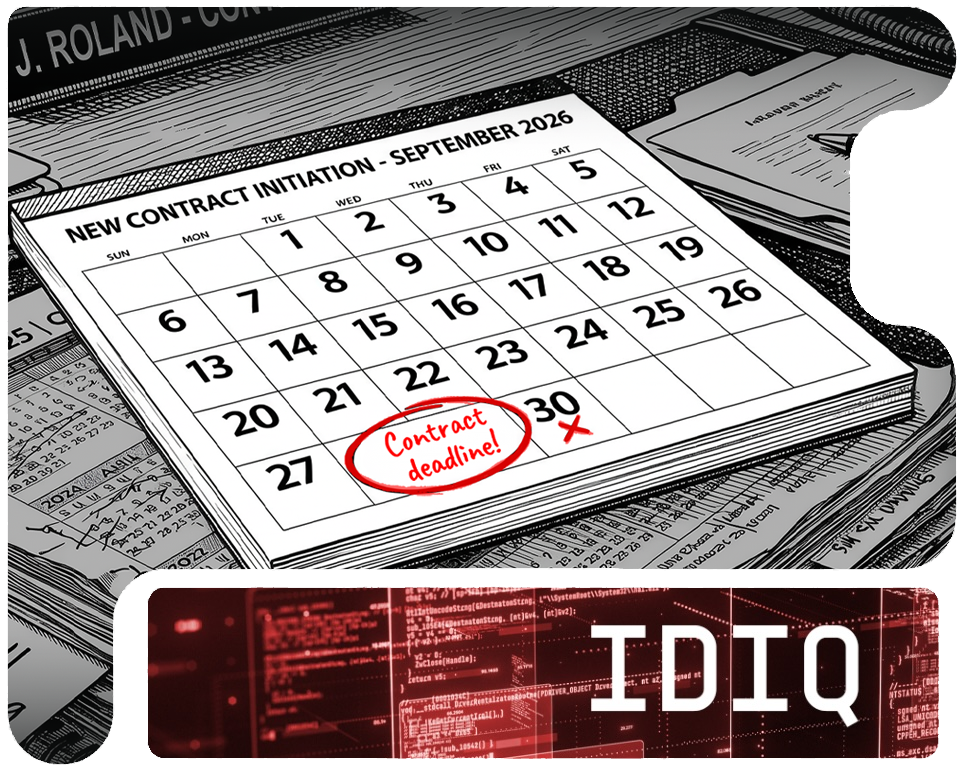
In our SoW, we promise the first mission outcome will be live in production within 180 calendar days of the performance start date. If we miss that deadline and it's on us, we keep working at no additional cost beyond what we already invoiced through the missed deadline, until the government accepts the outcome.
Whatever window you set, the commitment is worthless without airtight definitions, so define your terms. Here are our definitions:
A Mission Outcome is a user-facing capability deployed to and operating in Production, accepted by the government, and delivering a measurable improvement to the mission tied to the contract's objectives.
Production is defined as the environment where the latest versions of software are pushed live to the intended user population for intended operational use. This implies Authorization to Operate (ATO) under the Risk Management Framework. "Production" does not include development, test, staging, or pre-production environments, nor an environment labeled "Production" for another mission that does not reach the intended user population for intended operational use.
This closes the loophole that swallows most "agile" government contracts: the vendor who ships constantly to environments their intended user can't touch or use operationally. Prod or it didn't happen, written as an enforceable term.
Condition the deadline on the government's obligations
A contractor can't promise an outcome if the government withholds what they need, so condition the guarantee on the government's obligations too: decision-makers show up, access and credentials arrive on time, assessors answer within 72 hours, the agreed pipeline stays in place, users stay available, AI-assisted development tooling is allowed, and we keep our autonomy over user-centered design.
Our SoW specifies that when the government misses one of those conditions, the deadline moves day for day. Hit sixty cumulative missed days and the guarantee voids entirely, because at that point the failure isn't ours. And if the government sits on a finished outcome without accepting or rejecting it, we can force a written status determination after fifteen business days, so silent limbo stops being a free option.
Outcomes are co-produced, so the contract is too. The contractor's on the hook for the outcome, the government's on the hook for the dependencies that make it reachable.
Put real money behind the guarantee
Our SoW adds two commitments that put real money behind the guarantee.
The first is a year-one satisfaction guarantee. One named decision-maker, identified at award, can sign a single notice after the base year. If they're unhappy and the government still exercises the option year, the option-year price drops 10 percent.
The second carries the commitment into the option year and raises the bar from a single outcome to a steady pace: weekly production deployments and three outcomes a month per delivery lane, measured over rolling three-month windows.
The quarterly report's acceptance depends on a Net Promoter Score above 50 from real users, and that bar only applies if the government helps collect the responses, so we aren't graded on a test nobody took. Miss the pace with the government's conditions met, and it's a formal non-conformance under the FAR's inspection clause: we re-perform at no additional cost until we're back on track.
Year one guarantees first value delivery fast. Year two guarantees continuous delivery and happy users.
Turn the guarantees into enforceable deliverables
Words in the objectives stay words until they become deliverables with acceptance criteria. Our SoW makes the first outcome in production a deliverable in its own right, pins down a written definition of success inside the first 30 days, and times the year-one performance summary so the decision-maker has it in hand before the option call is due.
It also fixes the governance most contracts leave to chance: the SoW requires named decision-makers to attend the monthly meetings and quarterly Growth Boards, and their absence tolls the clock like any other unmet condition. And invoices track delivery and acceptance, not the passage of time.
Why this should be the default
The case comes down to three things.
It puts outcomes on the contract, not outputs. Features stay negotiable; the outcome—created via working software, in production, in users' hands, on a clock—is non-negotiable. That single inversion is the difference between buying mission value and buying paperwork.
It prices risk honestly. Free re-performance and a 10% satisfaction discount are real money. A vendor willing to sign this language is telling you something a past-performance volume never can. A vendor or PMO unwilling to sign it is telling you something too.
It stays inside the FAR. Nothing in our contract waives or supersedes the inspection, acceptance, changes, termination, or disputes clauses. We're not using an exotic vehicle or an OTA workaround. It's a firm-fixed-price task order any contracting officer can award today.
The barrier to outcome-based contracting was never the FAR. It was that nobody wrote the language. You can't fake outcomes in production, and it's time the contract stopped letting anyone try.