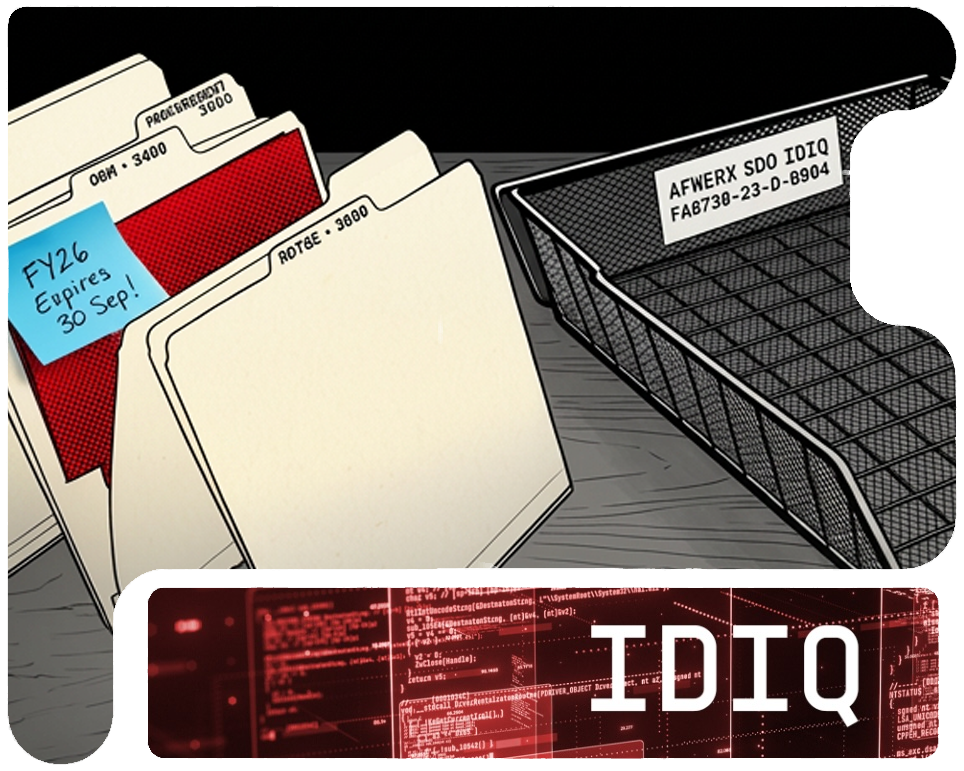
You know the date. September 30 is not a soft deadline. On October 1, any FY26 funds you haven’t obligated revert to the Treasury, and your software requirement waits another year.

A traditional software procurement takes eight to 18 months to award. If you’re sitting on a live requirement and unobligated FY26 money, the math doesn’t work in your favor. You can’t stand up a new RFP and get to award before the fiscal year closes.
One path still fits the calendar. The Space Force, Air Force, and Department of Veterans Affairs have already used it, it’s legal, and it gets your Contracting Officer to award in 30 days or less.
Why Traditional Software Procurement Won’t Get You There
The federal government's use-it-or-lose-it budget rules create a predictable pattern every September: program offices rush to obligate remaining funds under pressure, and the quality of what gets awarded suffers for it. Research from the National Bureau of Economic Research found that agencies spend roughly 4.9 times more in the final week of the fiscal year than in a typical week, and IT projects awarded in that window are two to six times more likely to receive a lower quality rating than projects awarded earlier in the year.
The problem isn’t program offices waiting until the last minute. The problem is that no one designed traditional software procurement for fiscal year timing.
A standard software contract acquisition timeline looks like this:
- Requirements definition: 30 to 60 days
- Market research: 30 to 60 days
- RFP preparation and public synopsis: 60 to 90 days
- Source selection and evaluation: 60 to 90 days
- Contract award and protest period: 30 to 60 days
Total: 8 to 18 months minimum.
That timeline doesn’t fit in a fiscal year. It certainly doesn’t fit in the 80 days between now and September 30.
If your program has a software requirement and FY26 funds to obligate, a new RFP isn’t a realistic path to award this year.
What the AFWERX SDO IDIQ Is
The Rise8 AFWERX Software Delivery Organization (SDO) Indefinite Delivery Indefinite Quantity (IDIQ) is a government-wide, single award contract vehicle with a $499M ceiling (ID FA873023DB004).
Under 15 U.S.C. 638, the SBIR Phase I and II awards that preceded this vehicle already satisfied all competition requirements. That means it doesn’t require new competition to award a Task Order under it.
No RFP. No market research. No source selection. No full FAR Part 6 Justification and Approval (J&A).
Your Contracting Officer documents Phase III eligibility with a short internal memo. AFWERX validates scope in two to three business days. Your local contracting shop issues the Task Order directly to Rise8.
That process makes 30 days or less realistic, not a marketing number. The vehicle isn’t a workaround or a loophole. Competition already occurred at the SBIR Phase I and II award stage. The IDIQ is the result of that competition. Every Task Order issued under it inherits that legal standing.
How 30 Days or Less Works: The Step-by-Step Process

No public synopsis. No industry day. No 30-day solicitation window. The original competition covered the steps that consume most of a traditional procurement's calendar.
Any Color of Money Qualifies
A common assumption about AFWERX vehicles is that they require RDT&E funding. The AFWERX SDO IDIQ accepts RDT&E (3600) for new capabilities, O&M (3400) for operational software and sustainment, and Procurement (3080) for COTS licenses and limited hardware. The vehicle charges zero government fees and doesn’t transfer any funds to AFWERX. Your FY26 appropriation goes directly to the capability.
The mechanics of how each appropriation type applies at the Task Order level, including how O&M funds agile iteration and what qualifies as sustainment, are coming soon in the next post in this series, keep an eye out for it.
It Has Been Done Before
The government has awarded eight Task Orders worth over $100M under this vehicle across the Space Force, Air Force, and VA, all on approximately 30-day timelines.
U.S. Department of Veterans Affairs: The VA became the first non-DoD federal civilian agency to achieve continuous Authority to Operate (cATO). Initial authorization time dropped 84 percent, from 568 days to 90 days. Security fixes accelerated by 75 percent.
U.S. Space Force: A scheduling system for Ops C2 increased operational throughput by 20 percent, created 150 additional usage days per year, generated an estimated $5 million in annual return on investment, and saved more than 34,000 hours of manual work.
Kobayashi Maru (USSF): 12 mission applications brought to 100 percent CYBERCOM compliance. Zero critical security findings. The work reclaimed more than 1,000 developer hours of manual security remediation.
These outcomes and achievements aren’t from pilots or proof of concepts; they’re mission impact from working software in production under awarded Task Orders.
Who Can Use This Vehicle
The AFWERX SDO IDIQ is a government-wide contract vehicle. Any DoW component, any federal civilian agency, and government-owned, contractor-operated (GOCO) organizations can issue a Task Order under it. You don’t need to have funded the original SBIR award, and you don’t need to be an Air Force program office.
What to Do If You Have Unobligated FY26 Funds
If your program office has a software requirement, unobligated FY26 funds, and a need to get on contract before September 30, the AFWERX SDO IDIQ is the most direct compliant path available to you.
We’re happy to jump on a quick 30 minute scoping call with you to see if your program is a fit for our SDO IDIQ. Rise8's Growth team will tell you whether your requirement fits the vehicle, which appropriation type funds it, and what a 30-day award timeline looks like for your specific program.
Not ready for a call? The DoW Acquisition Handbook covers the full statutory justification, the step-by-step ordering process, 20-year SBIR data rights protections, and the FAQ your contracting team may require for reference. Download the Handbook.
Frequently Asked Questions
Do I need to write a Justification and Approval (J&A) document?
You don’t need a full FAR Part 6 J&A. Under 15 U.S.C. 638, the SBIR Phase I and II awards that preceded this vehicle already satisfied competition requirements, so your Contracting Officer documents Phase III eligibility with a short internal memo rather than a J&A. Contracting Officers who need the full legal mechanics, specific FAR citations, and acquisition file documentation requirements should read Post 3 in this series. [Link: No J&A Required: How SBIR Phase III Authority Works for Contracting Officers]
Do I need to conduct market research or post a public synopsis?
No. FAR 10.001(b)(2) waives the market research requirement when you procure under a statutory exemption. The original competitive SBIR Phase I and II awards satisfy all competition requirements, and the statutory authority exempts the Task Order from further competition, public synopsis, and market research.
Can I use O&M funding for a software development Task Order?
Yes. In an agile framework, once a Minimum Viable Product is delivered, continuous iteration qualifies as sustainment. O&M can fund concurrent development, security patching, platform operations, and upskilling government personnel paired with Rise8 engineers.
My agency is not the Air Force. Can I still use this vehicle?
Yes. The AFWERX SDO IDIQ is a government-wide contract vehicle. The VA, a non-DoD federal civilian agency, has already awarded a Task Order under it. Any U.S. federal agency can issue a Task Order under FAR/DFAR-compliant Phase III acquisition guidelines. You do not need a prior relationship with AFWERX.
Is 30 days a realistic timeline, or is that aspirational?
30 days or less covers AFWERX scope validation (two to three business days), direct negotiation between your contracting shop and Rise8, and Task Order award. The competition and market research requirements are already fulfilled, which is what makes it achievable. Eight Task Orders worth over $100M have been awarded in approximately 30 days under this vehicle.
What capabilities does the vehicle cover?
The SDO IDIQ covers software development and deployment, DevSecOps and platform engineering, cybersecurity and continuous ATO (cATO) enablement, data modernization, cloud migration, legacy system transformation, user-centered design, and portfolio enablement. Task Orders can incorporate Firm Fixed Price labor, COTS software licenses, and IaaS/PaaS cloud infrastructure.
What if I need option periods on the Task Order?
Yes, the contract vehicle allows option periods. Organizations may specify the initial base period of performance and include single or multiple option periods to be exercised at the government's discretion.
Rise8 is the sole IDIQ holder for contract vehicle FA873023DB004, the AFWERX SDO IDIQ ($499M ceiling). Task Orders are awarded by the government customer's local contracting office directly to Rise8, under delegation of ordering authority issued by AFWERX.