RDT&E, O&M, and Procurement funds all qualify. Here's how each appropriation type applies at the Task Order level and what that means for your FY26 obligation deadline.
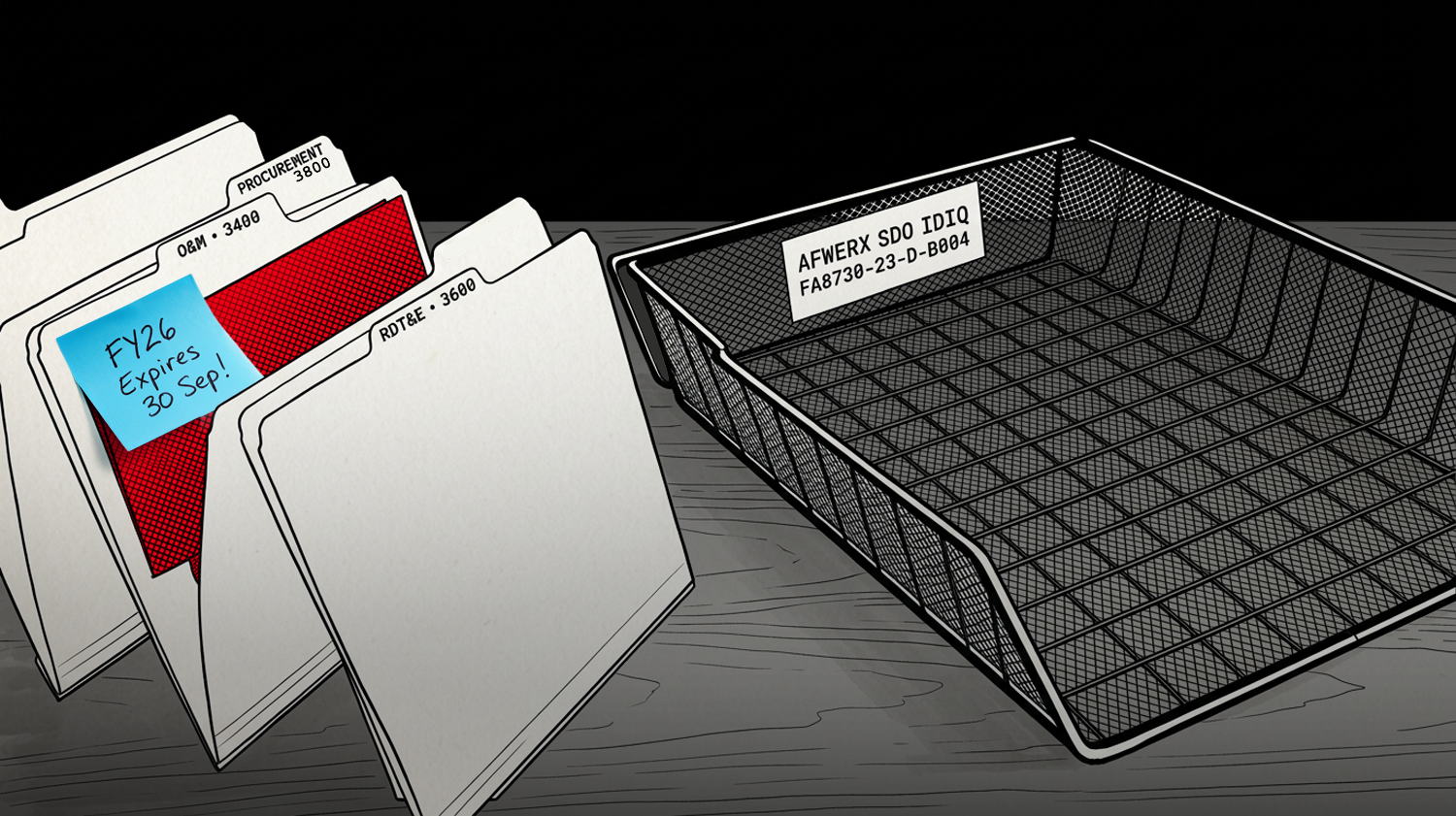
Which appropriations can fund a Task Order under the Rise8 AFWERX Software Delivery Organization (SDO) IDIQ? Short answer: RDT&E, O&M, and Procurement all qualify on contract FA873023DB004, a government-wide single award IDIQ with a $499M ceiling. Working Capital Fund dollars may work as well, read on to find out how.
The longer answer is worth understanding, because "any color of money" doesn't mean "no rules apply." It means the contract vehicle accepts each appropriation type for its proper purpose, and those purposes are broader than most program offices assume.
This post breaks down each appropriation type, whether it applies, and how. This content is for reference only. Consult your legal counsel before obligation decisions.
Why Appropriation Type Is a Common Blocker
Program offices that discover this contract vehicle often hit the same internal question: "Can I use my specific pot of money for this?" The question is a legitimate one. Contracting Officers are accountable for proper use of appropriated funds, and misapplying an appropriation is an Antideficiency Act violation, not a paperwork issue.
One assumption creates the bottleneck: because the AFWERX SDO IDIQ originated as a SBIR contract, many program offices assume it requires RDT&E funding.
But the vehicle supports the full lifecycle of software delivery. Modern software is never "done," and the line between development and sustainment in an agile environment is intentionally fluid. The appropriation types that apply to Task Orders under this vehicle reflect that reality.
RDT&E (3600): Research, Development, Test, and Evaluation
Applies: Yes.
RDT&E is the appropriation type most commonly associated with SBIR contracts, and it applies here. Use it for:
- Creating brand-new software capabilities where no operational system exists
- Standing up a DevSecOps environment and delivery pipeline from scratch
- The initial "R&D" phase of a project that will later transition to an operational system
RDT&E funds are available for obligation for two years, the fiscal year of appropriation plus one. FY26 RDT&E gives you until September 30, 2027 to obligate, more runway than one-year money. You don’t have to wait, though. Awarding task orders under this vehicle is achievable in 30 days or less, so you can put an FY26 RDT&E requirement on contract this fiscal year instead of carrying it into FY27.
O&M (3400): Operations and Maintenance
Applies: Yes, and more broadly than most Contracting Officers expect.
O&M is a one-year appropriation, which makes it the most common source of end-of-fiscal-year pressure. Most program offices also assume O&M can’t fund software development. In an agile context, that assumption is incorrect.
Once there is a Minimum Viable Product (MVP), continuous agile iteration qualifies as sustainment and modernization, not new development. That means O&M can fund:
- Continuous software updates and feature delivery on an operational system
- Security patching and vulnerability remediation
- Platform operations (cloud infrastructure, pipeline maintenance, monitoring)
- Training and up-skilling government personnel paired with Rise8 engineers
The SDO IDIQ emphasizes pairing Rise8 engineers directly with government personnel. Efforts focused on building internal government capability, not just delivering software, traditionally qualify as training under O&M. A Task Order that pairs your software factory engineers with a Rise8 delivery team to transfer knowledge and build internal capacity has a strong basis for O&M funding.
The bona fide need rule applies to all funding obligations, but O&M funds, particularly near the end of the fiscal year, usually get extra attention. The requirement you're funding must exist in FY26, and the goods or services must be delivered within the fiscal year or a reasonable time after. For services, the period of performance start date and the obligation date both matter. If your program has an operational software requirement for work in FY26, the bona fide need rule supports obligation before September 30.
Procurement (3080): Procurement Appropriations
Applies: Yes, for specific items within the Task Order scope.
Procurement appropriations fund the acquisition of new capital items: equipment, end-items, and in this context, commercial software licenses. Under this vehicle, Procurement funds apply to:
- Commercial Off-the-Shelf (COTS) software licenses included in the Task Order scope
- Limited hardware components required to support software delivery
Procurement funds are three-year appropriations for most DoW components, which provides more flexibility than O&M. If your program has unobligated Procurement funding and a software requirement that includes COTS licenses or hardware, this vehicle can accommodate it.
Working Capital Funds
Applies: Conditionally.
Working Capital Funds (WCF), including the Defense Working Capital Fund (DWCF), operate on a revolving basis and are not subject to the same annual availability rules as direct appropriations. WCF-funded organizations, like some logistics commands, depots, and research centers that have a software delivery requirement, can use the vehicle, but the specific authority to obligate WCF against a Task Order depends on the organization's charter and the nature of the requirement. Before proceeding, program offices using WCF should confirm with their legal counsel that the work falls within the funded activity's authorized mission.
No Government Fees. No Fund Transfer to AFWERX.
Regardless of appropriation type, the contract vehicle charges zero government fees to use. Your organization does not need to establish a MOU, MOA, Inter-Agency Agreement, or transfer funds to AFWERX through a MIPR. Your FY26 appropriation goes directly to the capability.
AFWERX administers the contract and validates scope, typically in two to three business days. Your local contracting office issues the Task Order and manages the obligation.
The IDIQ Provides the Vehicle, Not the Funding Determination
This principle applies across all four appropriation types above: RDT&E, O&M, Procurement, and WCF. The SDO IDIQ makes the contracting mechanism available — it doesn't decide which funding source is right for your requirement. That determination is still yours, made in consultation with your comptroller and legal counsel, for every task order regardless of appropriation type.
A Note on Mixed Appropriations
A Task Order under this vehicle can incorporate multiple funding sources when the work naturally spans appropriation types. A program might use RDT&E funds to stand up a new capability in the base period, then transition to O&M for sustained iteration in option periods. You can also split a Task Order between Procurement funds (for COTS licenses) and O&M (for the delivery team). The Task Order structure accommodates this. The key is that each funding line maps to work that fits the purpose of that appropriation.
Mixed appropriation Task Orders are common practice. Your Contracting Officer should document the funding split in the Task Order and ensure each line item maps to an appropriate use of funds.
The September 30 Constraint
For programs with FY26 O&M funding, September 30 is a hard obligation deadline. Your Contracting Officer must sign and fund the Task Order before that date. With a 30-day or less award timeline under this vehicle, a program that starts the scope validation process with AFWERX by mid-August has a realistic path to a signed Task Order before the fiscal year closes; notwithstanding any local deadlines for obligating expiring funds..
The first post in this series, Use It or Lose It: How to Obligate Your FY26 Budget Before September 30, covers the full step-by-step award process.
Quick Reference: Appropriation Types at a Glance
RDT&E (3600): Applies. New capabilities, DevSecOps environment standup, R&D phase of software projects. Two-year availability.
O&M (3400): Applies broadly. Agile iteration on operational software, security patching, platform operations, workforce training. One-year availability so September 30 is the hard deadline for FY26 O&M.
Procurement (3080): Applies for COTS licenses and limited hardware within the Task Order scope. Three-year availability.
Working Capital Funds: Conditionally applies. Confirm with legal counsel based on your organization's charter and mission.
What to Do Next
If your program has unobligated FY26 funds and a software requirement, Rise8's Growth team can tell you in a 30-minute scoping call whether your requirement fits the vehicle, which appropriation type funds it, and what a 30-day award timeline looks like for your specific program.
Not ready for a call? The DoW Acquisition Handbook covers the full statutory justification, the step-by-step ordering process, 20-year SBIR data rights protections, and the FAQ your contracting team may require for reference. Download the Handbook.
Rise8 is the sole IDIQ holder for contract vehicle FA873023DB004, the AFWERX SDO IDIQ ($499M ceiling). Task Orders are awarded by the government customer's local contracting office directly to Rise8, under delegation of ordering authority issued by AFWERX.