AI in production, outcome acquisition, compliance, and measurement, from the people doing it.
I headed to Prodacity for three days of keynotes and training about government software delivery. It was the first conference in a while that changed what is in my repositories rather than what’s in my notebook.
I came home and immediately got to work, applying what I learned to a website I have been writing on for a few years. Seventy-nine commits later, that site is a different piece of software.
The notebook still earned its keep — I captured the main takeaways from every session. Here are ten of them, compressed to the lesson each speaker left behind, so you can take what is useful and go apply it to your own program.
- Kent Beck, on futures: every feature you ship burns optionality, so build the pause between features into the work, and remember that no measure of effort or output is a measure of mission however easy it is to count.
- Russ Miles, on environments: AI amplifies whatever practice you already have, accountability cannot be handed to something that has no experience of consequence, and when the output is wrong the fix is usually in the environment and not in the prompt.
- Chris Hughes, on security: code volume and exploitation speed are both going vertical while assessment stays periodic and manual, and a security function that defaults to blocking has become the larger risk.
- Charles Nwatu, Lloyd Evans and Mario Lunato, on compliance: architect so that being compliant is the byproduct of how you already work, then check honestly whether you can fix findings at the rate a model can now find them.
- Jonathan Mostowski, on contracts: whatever is written on the contract is what you are actually buying, and every incentive you attach will produce a behavior you did not ask for.
- Lori-Ann Rissler, Ryan Connell and Dolores Kuchina-Musina, on acquisition: you cannot buy outcomes at output-level prices, and much of what slows a contracting shop down turns out to be local policy rather than regulation, which means somebody is allowed to delete it.
- Steve Pereira, on flow: the point of mapping is the shared model it builds, and the map itself can be thrown away, but the real risk now is everyone accelerating individually in a different direction.
- Paul Rayner, on domain: the knowledge you need is tacit, invisible and fragmented across silos, so get the right people in a room and visualize the process before anyone writes a specification.
- Patti Fletcher, on identity: nothing has reset until the capital and the calendar have reset, and divesting from what no longer matters is harder and more important than investing in what does.
- Dan Ward, on uncertainty: study your failures deliberately, build several scenarios instead of one forecast, and collect your signals from outside your own domain.
The pattern across all of them is the same, and it is why the last day landed the way it did. Every speaker was describing a constraint that had already moved, and a set of habits still aimed at where it used to be.
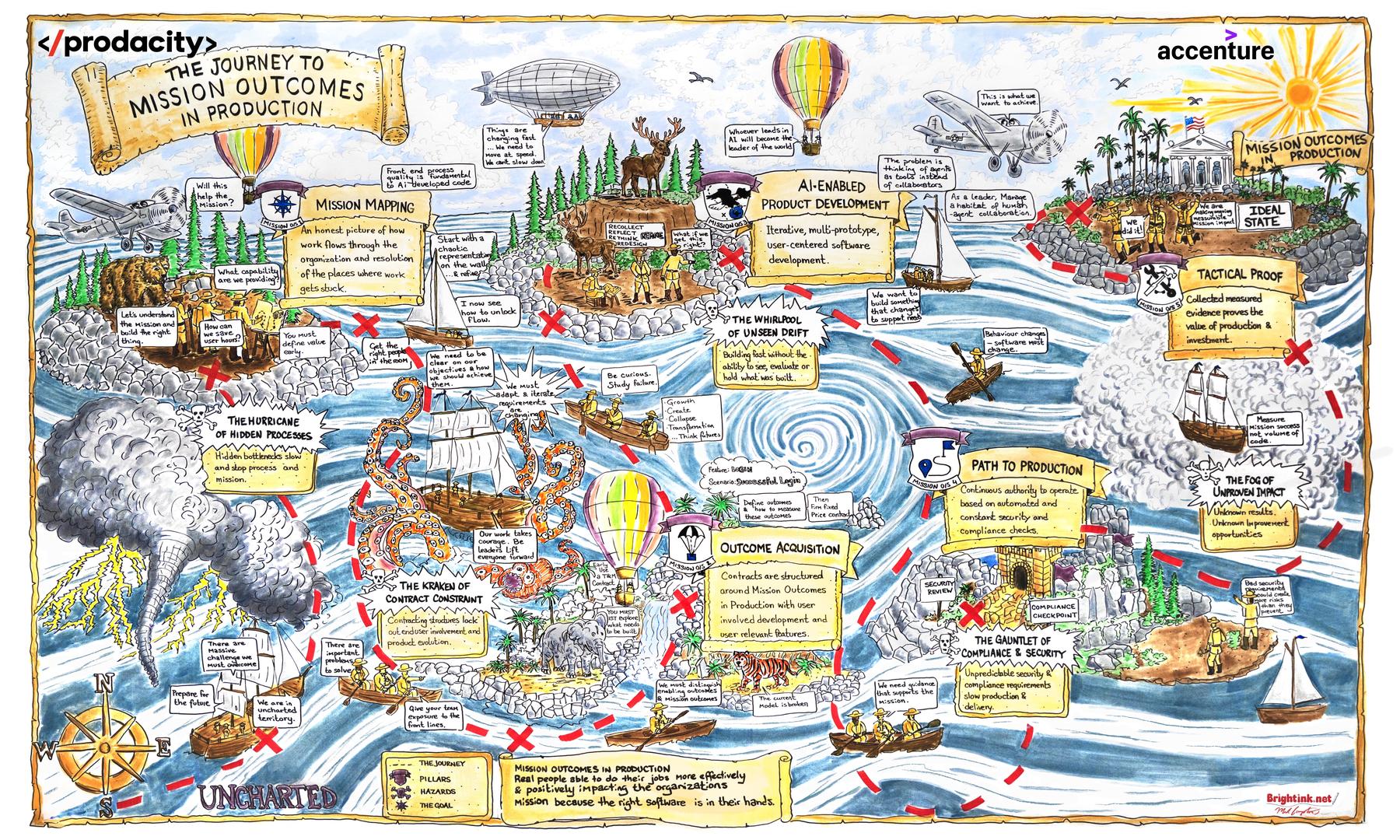
Illustrator Mark Compton graphically recorded the journey to mission outcomes in production while the talks were happening. Mission mapping to the left, push to production on the right, and a lot of weather in between.
None of the speakers gave me a destination I did not already know about. What they gave me was a name for the weather I was already in, which turns out to be the more useful thing. You cannot navigate around a storm you have not named. Pick the one on that map you are currently sitting in, then go do the smallest thing that gets you out of it.
Adapted from “Prodacity 2026: Living Harness, Dolly, and the 79 Commits in Three Days”, originally published on Jeff’s blog.